This is a screen capture of my board ‘Story Inspiration’. It’s where I save stuff I’ve found on Pinterest that sparks story ideas.
I have loads of boards. I have boards for character development, cover designs, mood boards, etc. I save useful articles for tips on writing, blogging, vlogs, etc. I’ve got boards with useful crafts, recipes and hair tutorials. I have used it for my sons homework, party planning and decorating rooms.
It is quite clear that I love Pinterest and find it incredibly useful. I haven’t used it much for socialising although I hope to get better at that.
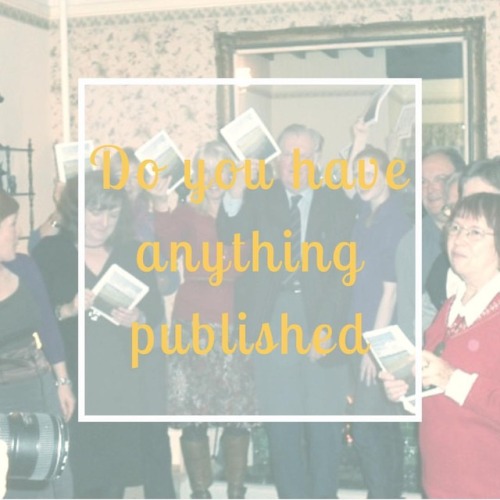
I had to dig out these pictures as they were taken in 2010 when my short contemporary romance was printed in the Scribblers Anthology. The proceeds of the sale went to charity, I think it was the East Anglian Childrens Hospice.
My first article was published when I just a kid by Leyton Orient in their fanzine. Over the years I’ve written a number of blog articles on a wide range of topics (writing, gaming, sex, fashion, conservation, etc).
My dream is to be a published author. I’ve lost count of the number of years I’ve worked towards this dream. One day, I will see my novel in a bookshop, I just feel like it is what I am meant to do. How about you?
Spring is when the calendar starts to get busier. As we get closer to the summer there are more festivals. Now is a good time to enter competitions.
In April #WriteMentor will open for potential mentees to apply for mentors. In May, there is The Bath Festival. If you prefer online events, be ready for #PitMad on 6 June.
I’m going to take this opportunity to remind you about the calendar I have been updating with literary dates and made accessible to all.
Google calendar
I created a public Google calendar so you can see everything I have added. If you want to copy an event then you too will need a google calendar (it is free with a free Google email account).
For this image, I used Unsplash to find an image of someone that looks like Kya. Mariah doesn’t really look up to anyone but she gets envious. Kya is someone she compares heself to and wishes she was more like.
My favourites
I really love how these challenges encourage me to share my writing with my instagram followers and on day 18 I got to post my favourite scene. Initially, I was going to share the underwater kiss as it is the scene that sparked the whole story. As I was looking for it, I decided to go with the moment before when Mariah’s life is changed forever.
Day 18 #FavouriteScene
March Challenge #WomenWritingFiction #WWFChallenge2019
This month I have decided to go with another Instagramers prompts. @Courtnimax has created the following Women Writing Fiction Daily Challenge for March 2019.
I hope you find these examples of the images I posted for February’s prompts interesting and inspiring. If you are a writer on Instagram please connect with me as I would love to see how you share your writing on the platform too.
I recently enjoyed a blog post on the pros and cons of writing by hand. It got me thinking about how I like to write.
Many people find it beneficial to write by hand. They feel the connection between the pen and paper and their words flow more clearly.
As a teen, I always wrote my stories in a notebook. I liked to write my ideas in the back and then fill it from the front, chapter by chapter. I liked to write in bed and my sheets were covered in ink stains
It wasn’t until I decided to take writing seriously that I began creating at a PC. I have never quite found a digital way to develop ideas that works like the back of a notebook but I do prefer writing on a computer. It’s easier to read than my handwriting, and editing is neater. Once finished I can easily prepare it for submissions.
Since switching to write electronic I haven’t used my notebooks for writing until recently.
Recently, I had an Instagram challenge to write somewhere different. It was a challenge to also boost creativity and it worked.
In fact, I enjoyed writing in my notebook so much I have since used it again. It makes developing my story and exploring ideas so much easier. Moving forward, I think I will continue to use it this way. Perhaps, treat myself to some new stationery…
Classifying your genre will be one of the first things you do. However, this may not be as simple as it sounds. Many novels, scripts and other works of art will combine elements of more than one genre within the story that is told. However, there will still be one main genre that flows steadily throughout your story (or series).
I watched Reign on Netflix. This series is classified as a Costume Drama. The main character is Mary Queen of Scots so some might say it is a Period Drama or Historical fiction, but to make compelling viewing the gripping storylines are fictional and I’ve seen it described as Fan Fiction. In addition, there is a lot of Political Drama and Religious Conflict. Many of the storylines are romantic making it Romance fiction.
https://youtu.be/8v8jS5_w8wA
Understanding Definitions
Sometimes the genre can be tricky to pinpoint as the definitions can be confusing and sound similar to each other.
I’ve had this issue trying to understand what is Magical Realism’? Or, what’s the difference between Urban Fantasy and Paranormal Romance? Then, some genres are based on the target audience of the reader i.e. by age (MG, Tween, YA, etc) or gender (Chick Lit) or personal identification (LGBTQ, Multicultural).
To tackle this, I suggest looking up the definitions online from more than one source. Also, check how novels similar to yours have been classified. Read novels of the genres you are considering and see which feels most similar to yours.
It is important to get this correct to enable the right readers to find your novel.
What if it is many genres?
Say you’ve written a YA, Historical Horror with a cross-dressing African bi-sexual and all the genres remain strong throughout the novel?
Then you have to ask yourself how similar novels have been classified or which market you feel your novel will thrive most strongly (i.e. if there is a current demand for Horror fiction, perhaps place it there).
Target audience:
Write for Kids has an article that goes into more detail on this subject – click here.
MG (Middle grade): For age 8 to 12. Length = 100 to 150 pages. The main character should be of a similar age. These books often form large series as children of this age will bond with the character and form an attachment.
Tween: For age 10 to 14. Length = around 150 pages. The main character should be of a similar age. These books are for children who have outgrown MG but are not ready for YA:
Young Adult: For age 12+. Length = 150 to 225 pages. The main character should be of a similar age, although due to the more mature theme the protagonist is often cast in their final year of high school:
Coming Of Age: This fiction will deal with the struggles of the protagonist going from being a child to becoming an adult.
Chick Lit: Literature for young women. The story will relate to the struggles young women face in a humorous way (i.e. dating, health, careers, finance, etc).
LGBTQ: The story will revolve around a character that is either lesbian, gay, bi-sexual, transgender or questioning their sexuality.
Multicultural: Books about people of colour and first/native nations.
Common Genres:
These are the main genres most people think of when classifying fiction:
Adventure: Often involves the characters being in danger and going through a series of events on a journey to reach their goal.
Romance: The novel usually follows a couple falling in love, often with lots of misunderstanding or barriers to give the story a journey.
Erotica: The novel will have steamy scenes as this is what the reader is investing in. Usually, there is a romantic plot to carry the story along but not necessarily important.
Horror: The novel should be scary and make you want to sleep with the light on. The idea is to strike fear into the reader and the characters.
Crime/Detective: Usually involves a murder but could be any crime. The protagonist could be trying to catch the culprit or could be the criminal.
Mystery: Involves following clues to solve a crime or to find out information.
Fan Fiction: The stories are based on characters from other artists works (i.e. Film, TV Show, Book, Play, etc) or famous people (i.e. a boy band, a royal, or an actress).
Suspense/Thriller: This story should have you sitting on the edge of your seat as you join the characters in evading whatever is lurking in the shadows after them.
Comedy/Humour: Written in an entertaining way with the goal of making the reader laugh.
World Setting Genres:
Historical: The story is set in a historical period of time – it is important to do your research to ensure you get your facts correct.
Western: Set in the American wild west between the eighteenth and nineteenth century.
Ghost/Supernatural: Story will challenge the fabric of our world. It often includes elements of other genres but the main focus is usually ghosts, spirits, demons, possessions and witchcraft.
Fantasy: Characters are set in an otherworldly setting. The story would not work in our world.
High Fantasy: The races and the world is made up. The main character is often a hero on a quest, usually good vs evil. Often includes battles involving combat or magic. This is your traditional classification.
Hard Fantasy: This involves heavy world building. The story will have a thoroughly developed world with geography, law, languages and reasons for why things are or are not (think Tolkien)
Techno Fantasy: Has the heart of fantasy but has a strong technology vibe. This could be through using technology to create something or someone. It could be where technology has come to life, for example, a car with a mind of its own.
Urban Fantasy: The story is set in the real world (usually present but can be set in the past or future). The story usually involves fantasy characters i.e. another race, species or paranormal or supernatural beings.
Paranormal Romance: Usually involves a romantic relationship between a human and supernatural (i.e. a vampire, witch, shapeshifter, ghost, time travel or someone with psychic abilities). Themes will mix with fantasy, science fiction and sometimes horror.
Magic Realism: Story involves magic or supernatural but presented within a realistic environment. The magic events are ordinary occurrences and not explained. There is something deeper connected to enlightening your mind of conventional constraints.
Science Fiction: Often set in the future or on another planet. The story is based on scientific ideas or imagined ideas.
Hard Science Fiction: The story will be supported by scientific facts and theories making the story more realistic and possible.
Length Classifications:
More information on this can be found on Fiction Factor:
Micro Fiction: Up to 100 words.
Flash Fiction: 100 to 1,000 words.
Short Story: 1,000 to 7,500 words.
Novelette: 7,5000 to 20,000
Novella: 20,000 to 50,000
Novel: 50,000 to 110,000
Epics/Sequels: 110,000+
Jewel of the sea
My novel Jewel of the sea (formerly Drift) is:
YA fiction: This is because my protagonist is a fifteen-year-old girl. She does turn sixteen within the novel and there is scope for a series.
Coming of Age: She starts her period, learns to wear makeup, has her first kiss, etc. Then there are all the firsts with her changing body… like becoming a mermaid.
Romance: The plot is driven by her crush on her best friend who is dating Kya. Kya’s brother (hot swim team captain and Mariah’s nemesis) offers to help break the couple up if she’ll kiss him – let’s just say it gets complicated.
Paranormal romance: She doesn’t know she is a mermaid and able to shift between her human and mermaid form. And she has weather manipulation powers. Plus the complicated romance (see above).
Urban Fantasy: The fantastical elements are set in a real world environment – it is loosely based around my hometown.
Novel: Currently it is 80k but I am constantly revising it.
I have classified it as a YA Urban Fantasy Novel.
What genre do you write?
Does your novel have multiple genres?
Please let me know if these descriptions helped you classify your novel’s genres.
This article was previously posted on my old blog and has been updated.
This is the first time I have done a photo prompt challenge but I really enjoyed it. It got me posting everyday and gave me a range of ways to share my writing and passion through photos.
Here are the highlights:
Top three photos from the challenge
This pictures are the ones that recieved the highest engagement on Instagram.
I have never had a photo do so well. I thing it was boosted by the increased engagement due to the daily activity but I got over 300 likes in less than 24 hours. This is ten times more than what I would get on a popular photo.
I think my new writer following was able to relate to this photo as I regramed a photo from @gracethewriter8 that really resonated with my dream. It is that hope that one day I will make it that keeps me going.
I decided to focus on just Jace as he is the love interest in both the projects I am working on. It is a love triangle and I decided to write it from both girls sides as seperate stories.
I went for the villian that is the catalyst for the story. Even though she doesn’t feature in Jewel of the sea, her actions is what send the crows to go soul snatching on their doorstep.
Personally, I like my projects to have a title before I start writing, some people don’t feel this necessary. My debut novel, currently being queried, was originally called Drift.
Here is a collection of some of the covers I have created for it over the years (there are more).
You will also notice one is called Wipeout as originally there was two books but during a brutal edit, I cut loads , they became one.
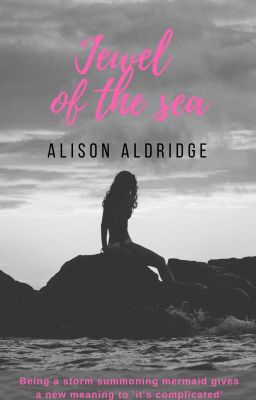
I have recently changed the title of Drift to Jewel of the sea. Here is the current cover and can be read on Wattpad.
If you would like to learn more about creating a novel title please check out today’s featured post by Lorraine. She shares her simple and easy to use tips on how she develops her novel titles. Here is the link to her article: http://lorraineambers.com/2018/03/31/creating-a-catchy-novel-title/
Happily Ever Author is a group run by Pagan on Facebook. She posts prompts to get authors to socialise and share what they are working on and to set goals. She sometimes gives prizes (I got a YouTube guide) and sometimes she promotes her books and other group (Paperback Kingdom).
Paperback Kingdom is a Facebook group linked to services she offers such a course, 1:1 coaching, etc. I can’t tell you much more as I’ve not paid for the additional content.
About #NewYearNewNovel
Pagan set her Happily Ever Author group members a challenge in December to start doing the prep work for a new novel in 2019. This was supported with videos where she shared her tips and techniques for doing this, from how to come up with a story idea, outling, character development, etc. These were really useful and I would like to watch them again.
Although, all I have written is the opening to my story (Scarlet House), I do feel more prepared and clearer about what I will be writing. I can’t wait to finish my current editing project so I can start on a brand new novel for 2019.
Have you discovered any awesome writer groups online?